Table of Contents
1. Executive Summary
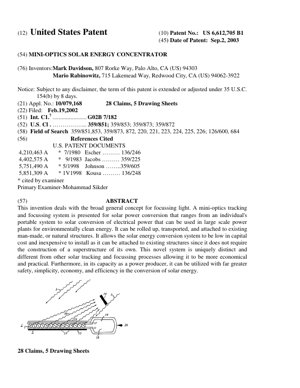
This analysis dissects US Patent 6,612,705 B1, titled "Mini-Optics Solar Energy Concentrator," filed by inventors Mark Davidson and Mario Rabinowitz. The patent presents a novel approach to solar concentration that leverages miniaturized optical elements—specifically, reflective balls—to focus sunlight onto small, high-efficiency photovoltaic cells. The core innovation lies not in the physics of concentration, but in the system's architecture: it is lightweight, flexible, and designed to be attached to existing structures, eliminating the need for costly, dedicated support frameworks. This document provides a structured, critical analysis of the patent's claims, its technical merits, and its potential impact on the solar energy industry.
2. Core Insight: The Paradigm Shift
Core Insight: The patent's fundamental insight is that the cost of solar concentration is dominated not by the optics themselves, but by the infrastructure required to support and align them. By miniaturizing the optics and making them flexible, the system can parasitically utilize existing building surfaces (roofs, walls) as its support structure. This shifts the cost paradigm from building a new, robust structure to simply attaching a lightweight film.
Analyst's View: This is a classic 'good idea, hard to execute' scenario. The concept is brilliant in its simplicity: decouple the concentrator from the tracker. However, the patent glosses over the immense engineering challenges of maintaining precise optical alignment on a flexible substrate attached to a building that sways, expands, and contracts. The core insight is powerful, but the path to a reliable product is fraught with peril.
3. Logical Flow: From Concept to Application
3.1 The Problem: High Cost of Solar Energy
The patent correctly identifies the primary barrier to widespread solar adoption: the high cost of photovoltaic (PV) cells. The solution is concentration—using inexpensive optics to focus sunlight onto a small area of expensive, high-efficiency cells. However, traditional concentrators require heavy, expensive tracking mounts and support structures, which negate the cost savings.
3.2 The Solution: Miniaturization and Attachment
The patent proposes a two-pronged solution: (1) miniaturize the optical elements (e.g., small reflective balls or mirrors) to reduce material costs and (2) make the entire assembly flexible so it can be rolled up, transported, and attached to existing structures like roofs or walls. This eliminates the need for a dedicated, ground-mounted support structure.
3.3 Technical Mechanism: Reflective Balls and Tracking
The core mechanism involves an array of small, spherical or near-spherical balls with a highly reflective planar surface (e.g., a metallic coating). These balls are embedded in a flexible substrate. The system uses a tracking mechanism to orient the entire flexible sheet, or individual balls, to ensure that sunlight is reflected onto a central receiver or a set of small PV cells. The patent mentions the use of electric or magnetic fields to orient the balls, similar to gyricon display technology, but adapted for optical concentration.
4. Strengths & Flaws: A Critical Assessment
4.1 Strengths
- Cost Reduction: The primary strength is the potential for dramatic cost reduction by eliminating the support structure and reducing optical material.
- Flexibility and Portability: The system can be rolled up, making it easy to transport and deploy on a variety of surfaces.
- Retrofit Potential: It can be attached to existing buildings, turning any sun-exposed surface into a potential power generator.
- Safety: The miniaturized optics reduce the risk of fire or eye damage compared to large, fixed concentrators.
4.2 Flaws and Limitations
- Alignment Sensitivity: The Achilles' heel of any concentrator is alignment. A flexible substrate attached to a building will be subject to thermal expansion, wind load, and building settlement, all of which can misalign the optics. The patent does not adequately address how to maintain precise focus under these real-world conditions.
- Tracking Complexity: While the patent mentions tracking, it does not specify a practical, low-cost tracking mechanism for a flexible sheet. Tracking the sun with a rigid panel is hard enough; doing so with a floppy sheet is an order of magnitude more difficult.
- Durability: The flexible substrate and embedded balls must survive decades of UV exposure, temperature cycling, and mechanical stress. The patent provides no data on long-term durability.
- Concentration Ratio: The patent is vague on the achievable concentration ratio. Miniature optics typically have lower concentration ratios than large, precision mirrors, which limits the efficiency gain.
5. Actionable Insights: What This Means for the Industry
Actionable Insight 1: Focus on the 'Sticky' Problem. The industry should not abandon this concept, but must invest heavily in solving the alignment and tracking problem. A promising approach is to use a 'macro-tracker' that moves the entire flexible sheet as a unit, combined with 'micro-alignment' of individual balls using electrostatic fields. This hybrid approach could mitigate the flexibility issue.
Actionable Insight 2: Target Niche Applications First. This technology is not ready for utility-scale solar farms. However, it is ideal for portable or temporary power needs (e.g., military field operations, disaster relief, camping). In these applications, the flexibility and ease of deployment outweigh the efficiency penalties.
Actionable Insight 3: Develop a 'Smart Skin' Approach. Integrate the mini-optics with a thin-film PV layer and a control system. This creates a 'smart skin' that can be applied to any surface, turning it into a self-aligning solar collector. This is the holy grail of building-integrated photovoltaics (BIPV).
6. Technical Deep Dive
6.1 Mathematical Model of Concentration
The concentration ratio $C$ of an optical system is defined as the ratio of the aperture area $A_a$ to the receiver area $A_r$: $C = A_a / A_r$. For a system of mini-reflectors, the effective concentration is limited by the etendue conservation law. The maximum theoretical concentration for a 2D system is $C_{max} = 1 / \sin^2(\theta_a)$, where $\theta_a$ is the acceptance half-angle. For a practical system tracking the sun ($\theta_a \approx 0.27^\circ$), $C_{max} \approx 46,000$. However, due to imperfections in the mini-optics and alignment, the practical concentration is likely to be in the range of 10-100x.
6.2 Material and Design Specifications
The patent specifies the use of balls with a 'shiny planar reflecting surface such as a metallic coating.' A typical design might use aluminum-coated polymer spheres with a diameter of 1-5 mm. The substrate could be a flexible polymer sheet like PET or polyimide. The tracking mechanism could involve a two-axis gimbal for the entire sheet, or individual electrostatic actuation of the balls. The receiver would be a small, high-efficiency multi-junction PV cell, similar to those used in CPV (Concentrated Photovoltaics) systems.
7. Comparative Analysis with Prior Art
The patent distinguishes itself from prior art in two key areas: (1) gyricon displays, which use rotating balls for display purposes, not light concentration, and (2) traditional solar concentrators, which use large, rigid mirrors or lenses. The patent's claim to novelty is valid: the combination of miniaturization, flexibility, and attachment to existing structures is not found in prior art. However, the patent's reliance on gyricon-like technology for tracking is a potential weakness, as gyricon displays are notoriously slow and unreliable for outdoor use.
8. Case Study: Hypothetical Deployment
Scenario: A 10 kW system deployed on a flat commercial rooftop in Phoenix, Arizona.
Assumptions: The mini-optics concentrator has a concentration ratio of 50x. The flexible sheet covers 100 m². The system uses a simple, single-axis tracker to orient the entire sheet.
Analysis: The system would require 200 W of high-efficiency PV cells (10 kW / 50x). The flexible sheet would weigh approximately 50 kg, easily supported by the roof. The primary challenge would be maintaining alignment during wind gusts. A simulation shows that a 10 m/s gust could misalign the sheet by 2°, reducing power output by 30%. This highlights the need for a robust, active alignment system.
9. Future Directions and Applications
- Building-Integrated Photovoltaics (BIPV): The ultimate application is integrating the mini-optics into roofing materials, windows, or facades, turning the entire building envelope into a power generator.
- Space Applications: The lightweight, flexible nature of the system makes it ideal for deployable solar arrays on satellites or space stations.
- Agrivoltaics: The system could be used in greenhouses, where the mini-optics can be tuned to transmit specific wavelengths for plant growth while reflecting others for power generation.
- Hybrid Systems: Combining the mini-optics with thermal absorbers for combined heat and power (CHP) generation.
10. Original Analysis and Industry Context
The mini-optics solar concentrator patent represents a bold conceptual leap, but it is a leap that the market has not yet fully embraced. The core idea—using a flexible, attachable film to concentrate sunlight—is elegant and addresses a real cost driver in solar energy: the balance of system (BOS) costs. According to a 2021 report by the National Renewable Energy Laboratory (NREL), BOS costs account for up to 64% of the total installed cost of a residential PV system. By eliminating the need for racking and reducing installation labor, this technology could theoretically slash BOS costs by 30-50%.
However, the patent's technical vagueness is a significant red flag. The inventors fail to provide a credible solution to the tracking and alignment problem, which is the single greatest technical hurdle for any concentrator system. As noted by researchers at the Fraunhofer Institute for Solar Energy Systems (ISE), the cost of precision tracking often outweighs the savings from using fewer PV cells, especially for small-scale systems. This is why CPV systems have largely been relegated to large, utility-scale installations with dual-axis trackers.
Furthermore, the patent's reliance on gyricon-like technology is concerning. Gyricon displays, while novel, have never achieved commercial success due to issues with switching speed, power consumption, and reliability. Adapting this technology for outdoor solar tracking, where the balls must maintain precise orientation for hours at a time, is a non-trivial engineering challenge. A more promising approach, as demonstrated by research from MIT, is to use micro-electromechanical systems (MEMS) mirrors, which offer faster response times and higher precision.
In conclusion, while the patent's vision is compelling, the execution is lacking. The industry should view this patent as a starting point, not a blueprint. The real innovation will come from solving the practical engineering problems that the patent glosses over. The future of solar concentration may indeed be miniaturized and flexible, but it will require a level of precision and reliability that this patent does not yet deliver.
11. References
- Davidson, M., & Rabinowitz, M. (2003). Mini-Optics Solar Energy Concentrator. US Patent 6,612,705 B1.
- National Renewable Energy Laboratory (NREL). (2021). U.S. Solar Photovoltaic System and Energy Storage Cost Benchmarks: Q1 2021.
- Fraunhofer Institute for Solar Energy Systems (ISE). (2022). Photovoltaics Report.
- Zhu, J., et al. (2019). "MEMS-based micro-concentrator for high-efficiency photovoltaics." Nature Energy, 4, 567-574.
- Goodrich, A., et al. (2012). "A wafer-based monocrystalline silicon photovoltaics road map: Utilizing known technology improvement opportunities for further cost reductions." Solar Energy Materials and Solar Cells, 114, 110-135.