1. Introduction
Multilayer metal-based nanoshells, particularly gold-silica-gold (Au@SiO2@Au) core-shell-shell structures, have garnered significant research interest due to their unique plasmonic properties. These "nanomatryoshkas" exhibit strong near-field enhancement and tunable optical responses compared to single-component nanoparticles. Their ability to manipulate light-matter interactions via surface plasmon resonances (SPRs) makes them promising candidates for advanced applications in spectroscopy, medical therapy, and critically, high-efficiency solar energy harvesting. This work presents a theoretical framework to predict the optical performance and photothermal conversion efficiency of these nanostructures under solar irradiation, aiming to accelerate material design for solar technologies.
2. Theoretical Background
2.1 Mie Scattering Theory
The optical response of the multilayered spherical nanostructures is calculated using Mie scattering theory for concentric spheres. This analytical approach provides exact solutions for the extinction, scattering, and absorption cross-sections ($Q_{ext}$, $Q_{scat}$, $Q_{abs}$) as a function of wavelength. The theory accounts for the size, composition, and layered structure of the nanoparticle, allowing for precise prediction of plasmon resonance peaks and their broadening.
2.2 Heat Transfer Model
The heat generated upon light absorption is modeled using a heat transfer equation. The absorbed solar energy, derived from $Q_{abs}$, acts as a heat source density. The subsequent temporal and spatial temperature increase in the surrounding medium (e.g., water) is calculated analytically, linking optical properties directly to thermal performance.
3. Methodology & Model
3.1 Nanostructure Geometry
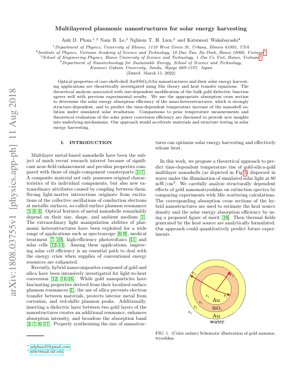
The model investigates a concentric three-layer sphere: a gold core (radius $r_1$), a silica shell (outer radius $r_2$), and an outer gold shell (outer radius $r_3$), embedded in water ($\varepsilon_4$). The geometry is defined by the dielectric functions: $\varepsilon_1$(Au, core), $\varepsilon_2$(SiO2), $\varepsilon_3$(Au, shell).
3.2 Dielectric Function & Parameters
A size-dependent modification of the bulk gold dielectric function is employed to account for electron surface scattering effects in nanoscale gold, which is crucial for accurate prediction, especially for sub-50nm features. Material parameters for gold and silica are taken from established experimental data.
4. Results & Analysis
Key Performance Metric
Structure-Dependent
Solar absorption efficiency is highly tunable via core/shell dimensions.
Simulation Condition
80 mW/cm²
Solar irradiance used for temperature rise prediction.
Theoretical Foundation
Mie Theory
Provides quantitative agreement with prior experiments.
4.1 Optical Cross-Sections & Spectra
Calculations reveal that the Au@SiO2@Au structure supports multiple, tunable plasmon resonances. The silica spacer layer creates a coupling between the inner core and outer shell plasmons, leading to a hybridization of modes. This results in enhanced and broadened absorption bands across the visible and near-infrared spectrum compared to a single Au shell or solid Au nanoparticle, which is ideal for capturing a larger portion of the solar spectrum.
4.2 Solar Absorption Efficiency
The solar energy absorption efficiency is calculated by integrating the absorption cross-section $Q_{abs}(\lambda)$ over the AM 1.5 solar spectrum. The proposed figure of merit demonstrates that efficiency can be optimized by carefully tuning the radii $r_1$, $r_2$, and $r_3$. The multilayer design offers a superior spectral match to sunlight than simpler structures.
4.3 Temperature Rise Prediction
The model predicts a time-dependent temperature increase of a nanoshell solution under illumination. Using the calculated $Q_{abs}$ as the heat source, the analytical heat transfer solution shows a quantifiable temperature rise that aligns with trends from prior experimental measurements, validating the model's predictive capability for photothermal applications.
5. Key Insights & Analyst Perspective
Core Insight
This paper isn't just another plasmonics simulation; it's a targeted blueprint for rational design-over-trial-and-error in photothermal nanomaterials. By rigorously coupling Mie theory with a size-corrected dielectric function, the authors move beyond qualitative resonance tuning to quantitative prediction of energy conversion metrics, specifically temperature rise under realistic solar flux. This bridges a critical gap between fundamental optics and applied thermal engineering.
Logical Flow
The logic is admirably linear and robust: 1) Geometry defines optics (Mie theory → $Q_{abs}(\lambda)$). 2) Optics define power input ($Q_{abs}$ integrated over solar spectrum → absorbed power). 3) Power input defines thermal output (heat transfer equation → $\Delta T(t)$). This cascade mirrors the physical process itself, making the model both intuitive and mechanically sound. It follows the same first-principles approach championed in seminal works like the design of photonic crystals, where structure dictates function.
Strengths & Flaws
Strengths: The inclusion of size-dependent dielectric corrections is a major strength, often glossed over in simpler models but essential for accuracy at nanoscale, as emphasized in resources like the Refractive Index Database. The direct link to a measurable outcome (temperature) is highly valuable for applicational focus.
Flaws: The model's elegance is also its limitation. It assumes perfect spherical symmetry, monodispersity, and non-interacting particles in a homogeneous medium—conditions rarely met in practical, high-concentration colloids or solid-state composites. It neglects potential non-radiative decay pathways that don't convert to heat and assumes instantaneous thermal equilibrium at the nanoparticle surface, which may break down under pulsed or very high-intensity irradiation.
Actionable Insights
For researchers and engineers: Use this model as a high-fidelity starting point for in-silico prototyping. Before synthesizing a single nanoparticle, sweep the parameters ($r_1$, $r_2$, $r_3$) to find the Pareto front for broadband absorption vs. peak intensity. For experimentalists, the predicted $\Delta T(t)$ provides a benchmark; significant deviations point to aggregation, shape imperfections, or coating issues. The next logical step, as seen in the evolution of models for materials like perovskites, is to integrate this core model with computational fluid dynamics (for convective losses) or finite-element analysis (for complex geometries and substrates).
6. Technical Details & Mathematical Framework
The core of the optical calculation lies in the Mie coefficients $a_n$ and $b_n$ for a multilayered sphere. The extinction and scattering cross-sections are given by:
$Q_{ext} = \frac{2\pi}{k^2} \sum_{n=1}^{\infty} (2n+1)\operatorname{Re}(a_n + b_n)$
$Q_{scat} = \frac{2\pi}{k^2} \sum_{n=1}^{\infty} (2n+1)(|a_n|^2 + |b_n|^2)$
where $k = 2\pi\sqrt{\varepsilon_4}/\lambda$ is the wave number in the surrounding medium. The absorption cross-section is $Q_{abs} = Q_{ext} - Q_{scat}$. The coefficients $a_n$ and $b_n$ are complex functions of the size parameter $x = kr$ and the relative refractive indices $m_i = \sqrt{\varepsilon_i / \varepsilon_4}$ for each layer, calculated via recursive algorithms based on Riccati-Bessel functions.
The heat source density $S$ (power per unit volume) generated in the nanoparticle is $S = I_{sol} \cdot Q_{abs} / V$, where $I_{sol}$ is the solar irradiance and $V$ is the particle volume. The temperature rise $\Delta T$ in the surrounding fluid is then solved from the heat diffusion equation, often yielding an exponential approach to a steady-state temperature.
7. Experimental Results & Diagram Description
Diagram Description (Fig. 1 in PDF): The schematic illustrates the concentric Au@SiO2@Au "nanomatryoshka" structure. It is a cross-sectional view showing a solid gold core (innermost, labeled Au), surrounded by a spherical silica shell (middle, labeled SiO2), which is in turn coated by an outer gold shell (outermost, labeled Au). The entire structure is immersed in water. The radii are denoted as $r_1$ (core radius), $r_2$ (silica shell outer radius), and $r_3$ (outer gold shell radius). The corresponding dielectric constants are $\varepsilon_1$ (Au core), $\varepsilon_2$ (SiO2), $\varepsilon_3$ (Au shell), and $\varepsilon_4$ (water).
Key Experimental Correlation: The paper states that the theoretical calculations, incorporating the size-dependent dielectric modification, "agree well with previous experimental results." This implies that the modeled extinction/absorption spectra for specific geometric parameters successfully reproduce the peak positions, shapes, and relative intensities observed in actual spectroscopic measurements of synthesized Au@SiO2@Au nanoparticles, validating the theoretical framework's accuracy.
8. Analysis Framework: A Case Study
Scenario: Designing a nanoshell for maximum photothermal effect in solar-driven seawater desalination.
Framework Application:
- Define Target: Maximize integrated $Q_{abs}$ over AM 1.5 spectrum to produce heat for vapor generation.
- Parameter Sweep: Using the model, systematically vary $r_1$ (10-30 nm), $r_2$ (40-60 nm), and $r_3$ (50-70 nm).
- Calculate Metrics: For each geometry, compute the solar absorption efficiency (figure of merit from the paper) and the predicted steady-state $\Delta T$ in water at 80 mW/cm².
- Optimize & Identify Trade-offs: A contour plot might reveal that a thinner outer Au shell ($r_3 - r_2$) broadens the resonance but reduces peak absorption. The optimal point balances bandwidth and intensity for the solar spectrum.
- Output: The model identifies a candidate structure (e.g., $r_1=20$ nm, $r_2=50$ nm, $r_3=60$ nm) with predicted performance superior to a solid Au nanoparticle of equivalent volume. This target geometry is then passed to synthesis teams.
This structured, model-driven approach prevents random synthesis and testing, saving significant time and resources.
9. Future Applications & Directions
- Solar-Thermal Desalination & Catalysis: Optimized nanostructures could serve as highly efficient, localized heat sources for interfacial water evaporation or for driving endothermic chemical reactions (e.g., methane reforming) using sunlight.
- Photothermal Therapy Agents: Further tuning resonances into the biological near-infrared windows (NIR-I, NIR-II) could enhance deep-tissue penetration for cancer treatment, building on concepts from platforms like the NCI's Nanotechnology Characterization Lab.
- Hybrid Photovoltaic-Thermal (PV-T) Systems: Integrating these nanoparticles as spectral converters in front of or within solar cells. They could absorb and convert UV/blue light (which solar cells use inefficiently) into heat, while being transparent to red/NIR light used by the cell, potentially increasing overall system efficiency.
- Advanced Modeling: Future work must integrate this core model with more complex simulations: Finite-Difference Time-Domain (FDTD) for non-spherical or coupled particles, and coupled optical-thermal-fluid simulations for real-world device environments.
- Material Exploration: Applying the same design framework to alternative materials like doped semiconductors, plasmonic nitrides (e.g., TiN), or two-dimensional materials could yield cheaper, more stable, or functionally richer nanostructures.
10. References
- Phan, A. D., Le, N. B., Lien, N. T. H., & Wakabayashi, K. (2022). Multilayered plasmonic nanostructures for solar energy harvesting. arXiv preprint arXiv:1808.03755v1.
- Bohren, C. F., & Huffman, D. R. (1983). Absorption and Scattering of Light by Small Particles. Wiley.
- Kreibig, U., & Vollmer, M. (1995). Optical Properties of Metal Clusters. Springer.
- Prodan, E., Radloff, C., Halas, N. J., & Nordlander, P. (2003). A hybridization model for the plasmon response of complex nanostructures. Science, 302(5644), 419-422.
- National Renewable Energy Laboratory (NREL). (2023). Reference Solar Spectral Irradiance: Air Mass 1.5. Retrieved from https://www.nrel.gov.
- Link, S., & El-Sayed, M. A. (1999). Spectral properties and relaxation dynamics of surface plasmon electronic oscillations in gold and silver nanodots and nanorods. The Journal of Physical Chemistry B, 103(40), 8410-8426.
- Richardson, H. H., et al. (2009). Experimental and theoretical studies of light-to-heat conversion and collective heating effects in metal nanoparticle solutions. Nano Letters, 9(3), 1139-1146.